
01
Three things
became true
at once.
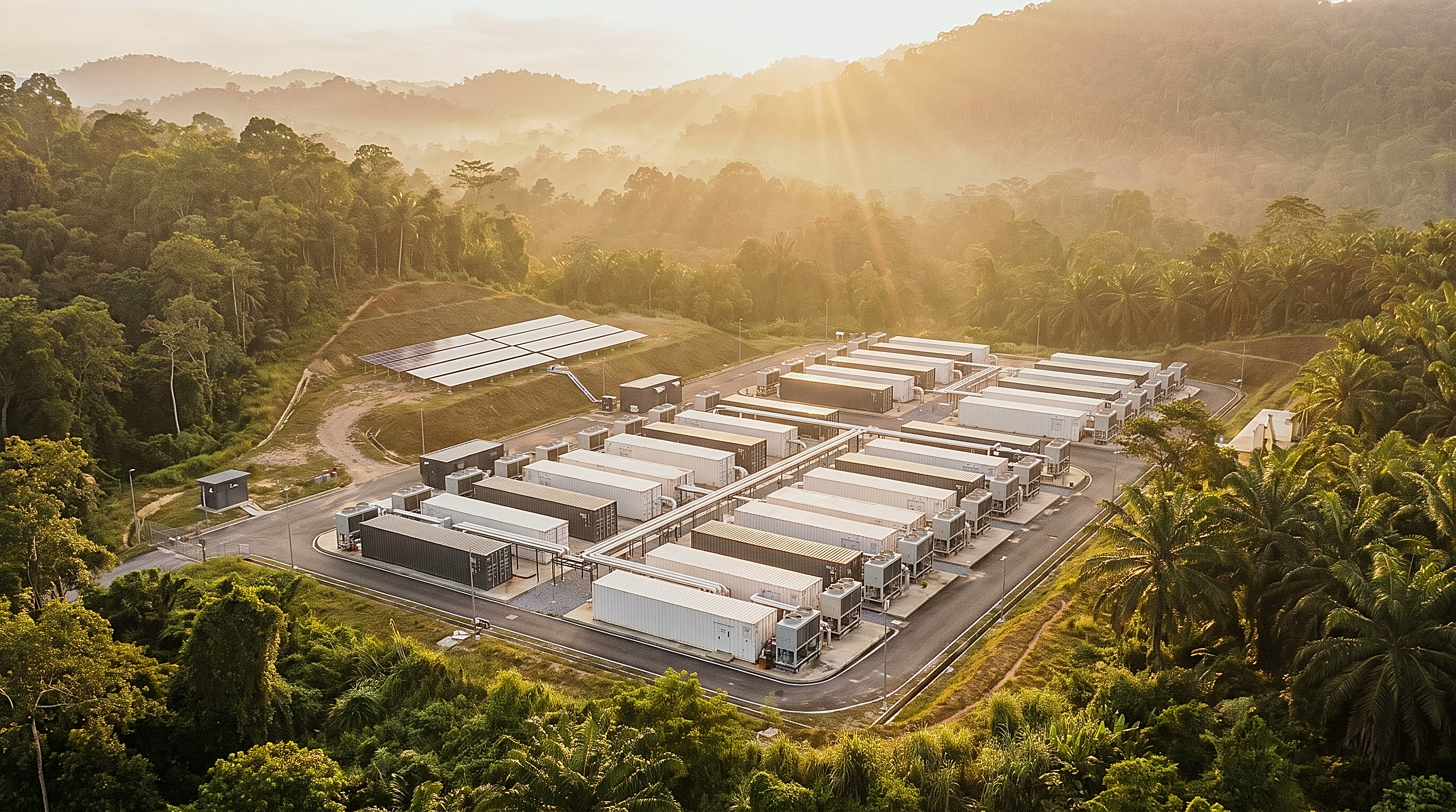
Solar got cheap. Storage got cheap. And the world ran out of places to plug computers in.
Any one of those alone changes little. Together they make a self-powered compute facility buildable for the first time — not newly imagined, newly possible.
What constrains this expansion is not capital. It is power.
Volume I · Chapter 8B02
Why Malaysia.
Why now.
Four facts, and a window that will not stay open.
Fact 01
Light and land
A strong year-round solar resource, and extensive underused land suited to off-grid generation.
Fact 02
A grid getting dearer
On 1 July 2025 the Peninsular base tariff rose about 13.6%, from 39.95 to 45.40 sen/kWh (Energy Commission, RP4). Connection constraints add delay to conventional compute expansion.
Fact 03
Capital discipline
Founding and hub capital are equity-first. Any future capital option is assessed only after operating assets justify it.
Fact 04
A narrow window
First movers set the terms. Once this is ordinary, the advantage is gone.
The platform does not depend on external financing fashions. Its present plan is conventional equity, structured around operating milestones and counterpart fit.
03
The land
the grid forgot.
Tin pools. Spent plantations. Stranded state land. All of it was written off for one reason: it sat too far from cheap power.
Generate power at the site and that defect stops mattering. The thing that made the land worthless is the thing that makes it cheap.

The grid drew the map of what was valuable. It is not the only map that could have been drawn.
Volume I · Chapter 304
Three asymmetries
that widen.
Not advantages that erode. Advantages that compound.
- Cost durability.
- A tariff is renegotiated against you. Sunlight is not. Build the generator once and the next kilowatt-hour costs almost nothing, for twenty-five years.
- Political surface area.
- Draw nothing from the national grid and you compete with no household for power. As connection policy becomes more selective, an off-grid model avoids competing for the same queue.
- Geographic optionality.
- Free of the grid, siting follows sun, water and land price — not substation queues. That opens ground overlooked by grid-connected operators.
The grid-connected model concentrates infrastructure where power is cheap. The off-grid model distributes infrastructure where land is idle. These are not the same business.
Volume I · Chapter 405
One hub is a project.
Ten is a platform.
Ten hubs are not ten times one hub. Risk spreads. Build cost falls with practice. Instruments become available that no single site could carry.
Distribution is also discipline: each hub is built from small ports that use all their own power, off grid, so a fault in one port stops only that port. Each site’s licensing route is confirmed with the Energy Commission before financial close.
Add ten hubs together and you do not get ten times one hub. You get something the arithmetic cannot describe.
Volume I · Chapter 11Figures are planning ambitions drawn from Volume I, not results. Nothing here is a forecast of revenue or return.